
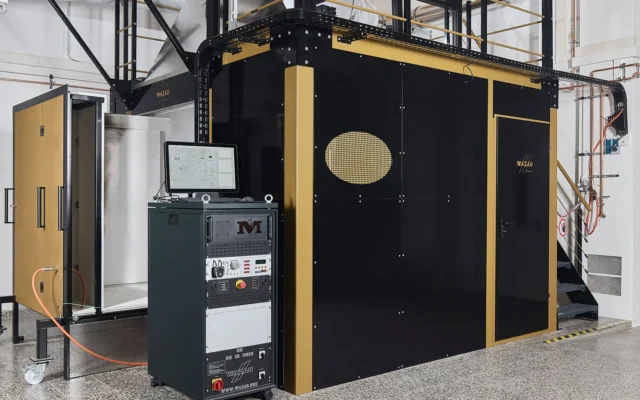
As part of its comprehensive range of services for various products, the Entwicklungs- und Prüflabor Holztechnologie GmbH (EPH) is a European-notified testing laboratory and product certification body. As a horizontally notified fire testing body, it already offers fire tests in accordance with EN ISO 9239-1, EN ISO 11925-2, EN ISO 1716 and EN ISO 1182. Beyond that, EPH is a recognised fire testing body in accordance with IMO Resolution MSC.307 (88) 2010 FTP Code – Parts 1 and 5.
Since 12 May 2026, the EPH has held DAkkS accreditation for testing using the ‘SBI fire test stand’ in accordance with EN 13823:2020+A1:2022 (Reaction to fire tests for building products – Building products excluding flooring exposed to the thermal attack by a single burning item;).
Why is this test method important?
As part of European efforts to simplify and harmonise market access requirements and trade in building products, a new system for classifying building products according to their reaction to fire was introduced with the standard EN 13501-1. This classification has since become increasingly widespread and has replaced national classification systems.
With the exception of flooring and tubular cladding, the newly developed ‘SBI’ test method has thus become the most significant test method in the classification process for all building products that are, in principle, combustible and are not intended to be classified in the lowest classes.
The requirements for building products and their use in buildings are set out in the national regulations of European countries. Within Germany, these are the German federal state building regulations, which are specified in more detail, where necessary, by supplementary provisions in the Technical Building Regulations. On behalf of the federal states, the DIBt publishes the Model Administrative Regulation on Technical Building Regulations (MVV TB), in which Annex 4, Tables 1.1 and 1.2 also set out the correspondence between the building control definitions and the reaction to fire of building materials – in other words, a kind of translation of the European fire class into the building control requirement according to A 2.1.2 (MVV TB) using the terms ‘flame-retardant | hardly flammable | low flame spread characteristics’ and the old national fire classes ‘B1’ and ‘B2’.
What happens during an SBI test?
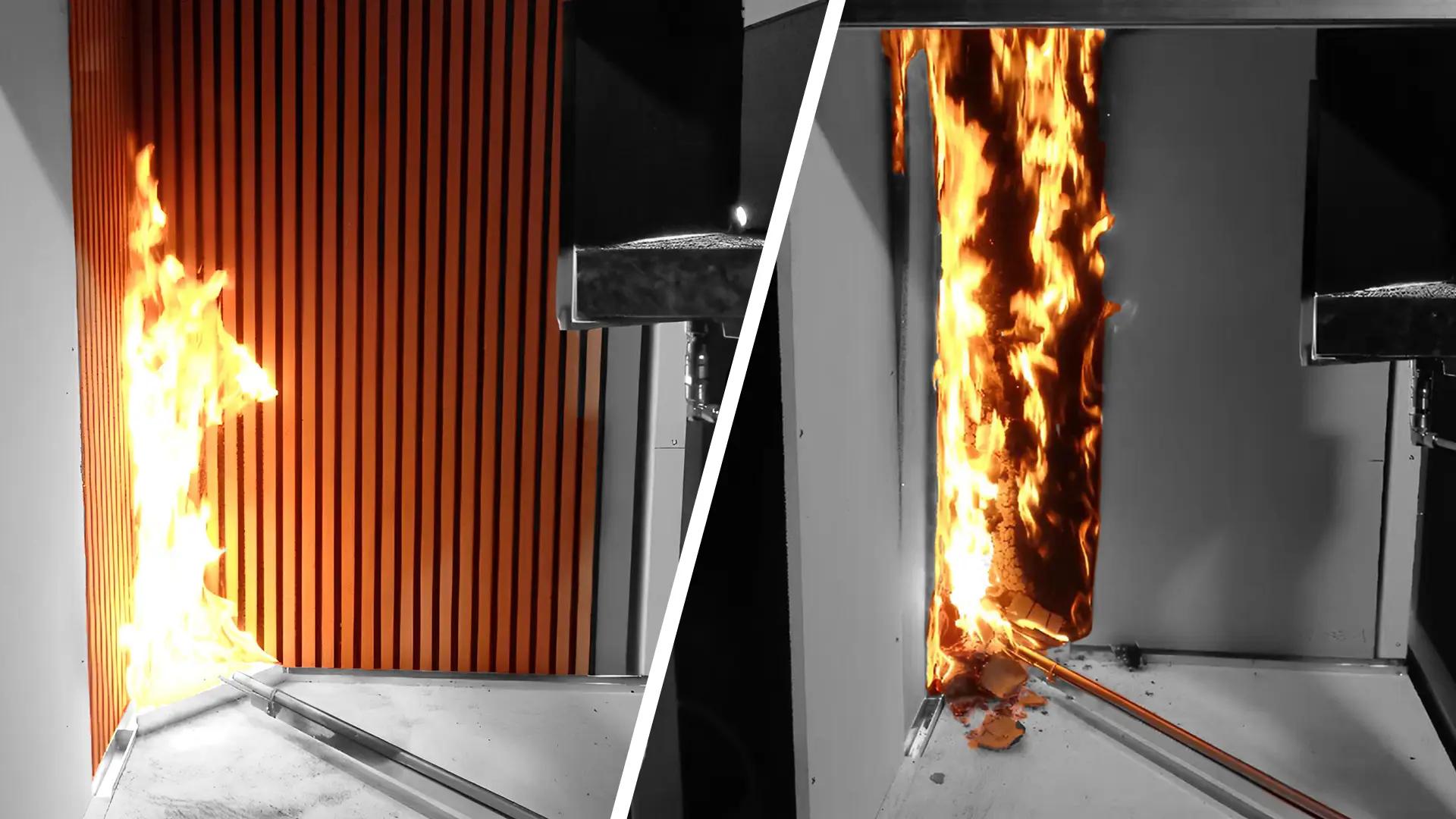
The Single-Burning-Item (SBI) test is a test method for the determination of the reaction to fire of building products and simulates a situation in which a building product is exposed to the direct flames of a single, already burning object. In the SBI test rig, this situation is simulated by a propane-fuelled burner with a heat release rate of (30.7 ± 2) kW, whose flame is distributed across a triangular surface via a bed of gravel or sand and makes direct contact with the inner corner of a two-wing test specimen.
The SBI test rig consists of a walk-in chamber with internal dimensions of 3 m × 3 m and a height of 2.4 m, one side of which has an opening that is sealed by a roll-out test specimen trolley. A test specimen – consisting of two sides (wings) positioned at a 90-degree angle to one another – with a height of 1500 mm and wing lengths of 500 mm and 1000 mm respectively, is secured to the test trolley for testing. This trolley is positioned in the SBI- test rig beneath a defined extraction system.
Access to the exhaust pipe and the measuring points located within it is gained from the level above the walk-in chamber. This area is the most technically sophisticated and complex part of the test rig: inside the designated pipe for the discharge of all combustion gases are the gas sampling probe for the determination of the oxygen and carbon dioxide content of the flue gas, a differential pressure sensor for the measurement of the flue gas velocity, a system for determining the light attenuation caused by the resulting smoke, and temperature sensors.
A notable feature of the new SBI test rig, which is used in the EPH fire laboratory, is the downstream, sophisticated exhaust air purification system designed to prevent emissions into the urban atmosphere.
Which criteria and parameters relevant to classification are recorded?
The duration of the fire exposure described is 20 minutes, and during the attempt, several reactions of the building products to the effects of this sustained flame are examined: the heat and smoke release rates are determined, and further properties are recorded visually through continuous observation.
The measurements and observations are compared with the classification requirements set out in EN 13501-1, from which the achieved reaction to fire classification can be determined.
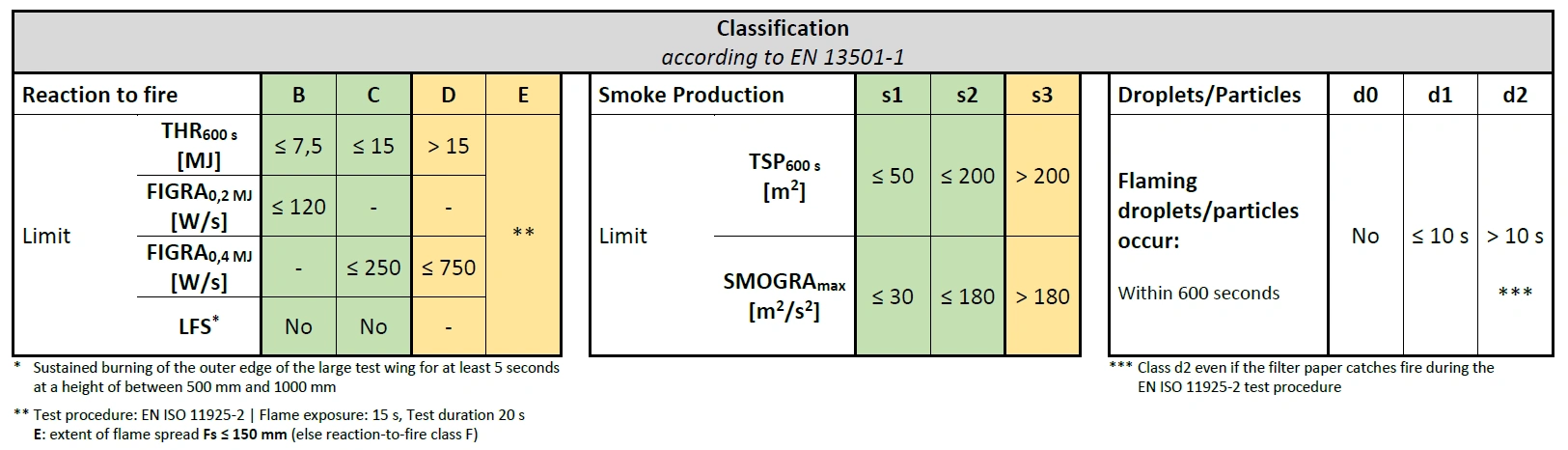
Criteria or classification parameters employed for classification:
- THR600 s , (Total Heat Release in MJ): a calculated parameter that indicates the total energy (heat) released by the sample during the first 600 seconds of exposure to the main burner flame.
- FIGRA0,2 MJ , (FIre Growth RAte index in W/s): is the calculated maximum value of the function FIGRA(t) = HRRav(t)/t (= mean heat release rate divided by the corresponding time), whereby, in determining this maximum, only values from the time at which the total heat release THR reaches or exceeds the threshold value of 0.2 MJ are taken into account.
- FIGRA0,4 MJ , (FIre Growth RAte index in W/s): is the calculated maximum value of the function FIGRA(t) = HRRav(t)/t (= mean heat release rate divided by the corresponding time), whereby, in determining this maximum, only values from the time at which the total heat release THR reaches or exceeds the threshold value of 0.4 MJ are taken into account
- LFS (Lateral Flame Spread): observed lateral (horizontal) flame spread into a determined section of the wide test wing over a determined period of time
Classification parameters also include (for index ‘s’ and index ‘d’):
- TSP600 s (Total Smoke Production): a calculated value representing the total amount of smoke released during the first 600 seconds of fire exposure.
- SMOGRA (SMOke Growth RAte index): A calculated maximum value obtained by dividing the smoke growth rate by the corresponding time.
- Flaming particles or droplets (index ‘d’) into a determined chapter of the test trolley over a determined period of time
Other external events or observations are of an informal nature only.
What does my achieved classification indicate, and what does it refer to?
For most fire classes under the EN 13501-1 classification standard, more than just compliance with a single test standard is required. Thus, even for fire classes D, C, B and, in some cases, A2, the SBI test is only one of the required tests. The table above is therefore not exhaustive.
Good to know: The accredited/horizontally notified EPH fire testing laboratory can offer all test methods specified in EN 13501-1 and can therefore perform the determination of all fire classes (including those for flooring).
However, even with two tests, it is not possible to characterise and take into account all real-life fire situations. This important point is addressed in Chapter 10 of the SBI test standard EN 13823 by the requirement that the test report must (verbatim) include the subsequent sentence: “The test results relate to the behaviour of the test specimens of a product under the particular conditions of the test; they are not intended to be the sole criterion for assessing the potential fire hazard of the product in use.”
Equally important, and a point that should not be underestimated, is the ‘scope of application’. This indicates the situations or conditions under which a classification for the building product applies.
Chapter 15 of the classification standard EN 13501-1 states: ‘The scope of application of the classification is identical to the scope of application resulting from the test […]’ ’
There are further, more detailed determinations of this kind – some of which are limited to specific product groups – which aim to clearly define the scope of the classification achieved in a test. This means that it is not the building product alone, but the method of installation (assembly variants or application quantities for coatings) and the sample fixing method employed in the test that are crucial for determining what the classification ultimately applies to. This is something that should be considered before an SBI test, as this test is very resource-intensive and requires a significant amount of material.